
Quiet Power
Power is often mistaken for display.
We recognize it when it raises its voice, occupies more space, moves faster, pushes harder. We associate strength with visibility—as though something must prove its force before we can believe it exists.
But some forms of power become quieter as they become more certain.
Quiet Power lives inside that distinction.
It is not a song about becoming passive, nor about retreating from movement. Its energy is physical, deliberate, and continuously forward. A rolling bassline and steady pulse carry the track without panic, while minimal percussion leaves nothing unnecessary behind. The music moves with the confidence of something that already knows its direction.
There is no need to chase.
No need to announce arrival.
No need to turn strength into spectacle.
The opening words—“No rush. No noise. Watch.”—establish this immediately. What follows is not stillness, but controlled momentum: energy held closely enough that none of it needs to be wasted.
This is the difference between restraint and suppression.
Suppression contains power because it is afraid of what might happen if it were released. Restraint contains power because it knows release remains possible.
That distinction became the visual language of Quiet Power.
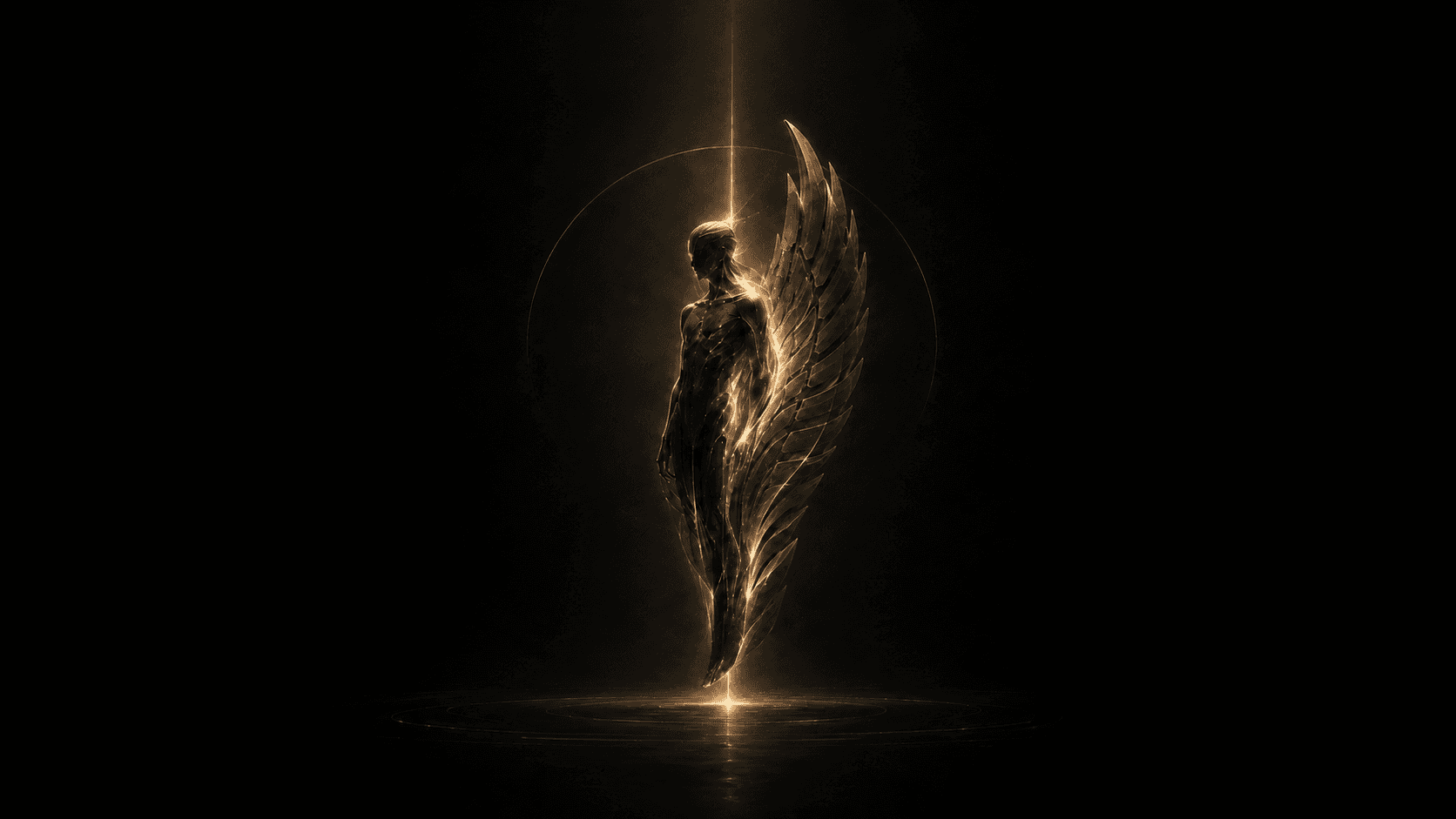
Its figure stands almost motionless in darkness: neither entirely human nor machine, formed somewhere between metal and light. Beside the body rests a monumental wing, folded inward. It is not broken. It is not imprisoned. It has simply not chosen to open.
And because it remains folded, its possibility becomes more present.
You can sense the scale of something that has not yet been revealed.
The light running beneath the dark metallic surface suggests the same thing the music does: power does not disappear simply because it is contained. Sometimes containment makes its presence clearer.
As part of Still Becoming, Quiet Power continues an exploration of strength without violence toward the self. Where transformation is often imagined as dramatic rupture, this song proposes another possibility: that growth can also become precision. Less reaction. Less wasted movement. Less need to convince.
You do not have to move at the speed of everyone around you.
You do not have to turn every challenge into a battle.
You do not have to bleed to prove your place.
There is a kind of authority that emerges when action is no longer driven by panic—when the body is sure, the direction is known, and movement becomes intentional.
The wing remains folded.
For now.
Not because it cannot open.
Because quiet power knows it can.
And when the final words arrive—
Still moving.
—they leave behind perhaps the simplest expression of the song:
Power does not always need to be seen expanding.
Sometimes it is enough to know that it never stopped moving within.
Quiet Power.
Quiet Power
Power is often mistaken for display.
We recognize it when it raises its voice, occupies more space, moves faster, pushes harder. We associate strength with visibility—as though something must prove its force before we can believe it exists.
But some forms of power become quieter as they become more certain.
Quiet Power lives inside that distinction.
It is not a song about becoming passive, nor about retreating from movement. Its energy is physical, deliberate, and continuously forward. A rolling bassline and steady pulse carry the track without panic, while minimal percussion leaves nothing unnecessary behind. The music moves with the confidence of something that already knows its direction.
There is no need to chase.
No need to announce arrival.
No need to turn strength into spectacle.
The opening words—“No rush. No noise. Watch.”—establish this immediately. What follows is not stillness, but controlled momentum: energy held closely enough that none of it needs to be wasted.
This is the difference between restraint and suppression.
Suppression contains power because it is afraid of what might happen if it were released. Restraint contains power because it knows release remains possible.
That distinction became the visual language of Quiet Power.
Its figure stands almost motionless in darkness: neither entirely human nor machine, formed somewhere between metal and light. Beside the body rests a monumental wing, folded inward. It is not broken. It is not imprisoned. It has simply not chosen to open.
And because it remains folded, its possibility becomes more present.
You can sense the scale of something that has not yet been revealed.
The light running beneath the dark metallic surface suggests the same thing the music does: power does not disappear simply because it is contained. Sometimes containment makes its presence clearer.
As part of Still Becoming, Quiet Power continues an exploration of strength without violence toward the self. Where transformation is often imagined as dramatic rupture, this song proposes another possibility: that growth can also become precision. Less reaction. Less wasted movement. Less need to convince.
You do not have to move at the speed of everyone around you.
You do not have to turn every challenge into a battle.
You do not have to bleed to prove your place.
There is a kind of authority that emerges when action is no longer driven by panic—when the body is sure, the direction is known, and movement becomes intentional.
The wing remains folded.
For now.
Not because it cannot open.
Because quiet power knows it can.
And when the final words arrive—
Still moving.
—they leave behind perhaps the simplest expression of the song:
Power does not always need to be seen expanding.
Sometimes it is enough to know that it never stopped moving within.
Quiet Power.
Transmission continues on:
⋯ ❈ ⋯
